
LANDMINES…
What is a Landmine?
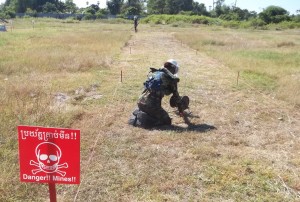
Antipersonnel landmines claim victims in every corner of the globe each day. Incapable of distinguishing between the footfall of a soldier and that of a child, they remain a threat long after the end of a conflict. Antipersonnel landmines are explosive devices designed to injure or kill people. They lie dormant for years and even decades under, on or near the ground until a person or animal triggers their detonating mechanism. Antipersonnel mines cannot be aimed: they indiscriminately kill or injure civilians, soldiers, peacekeepers and aid workers alike.
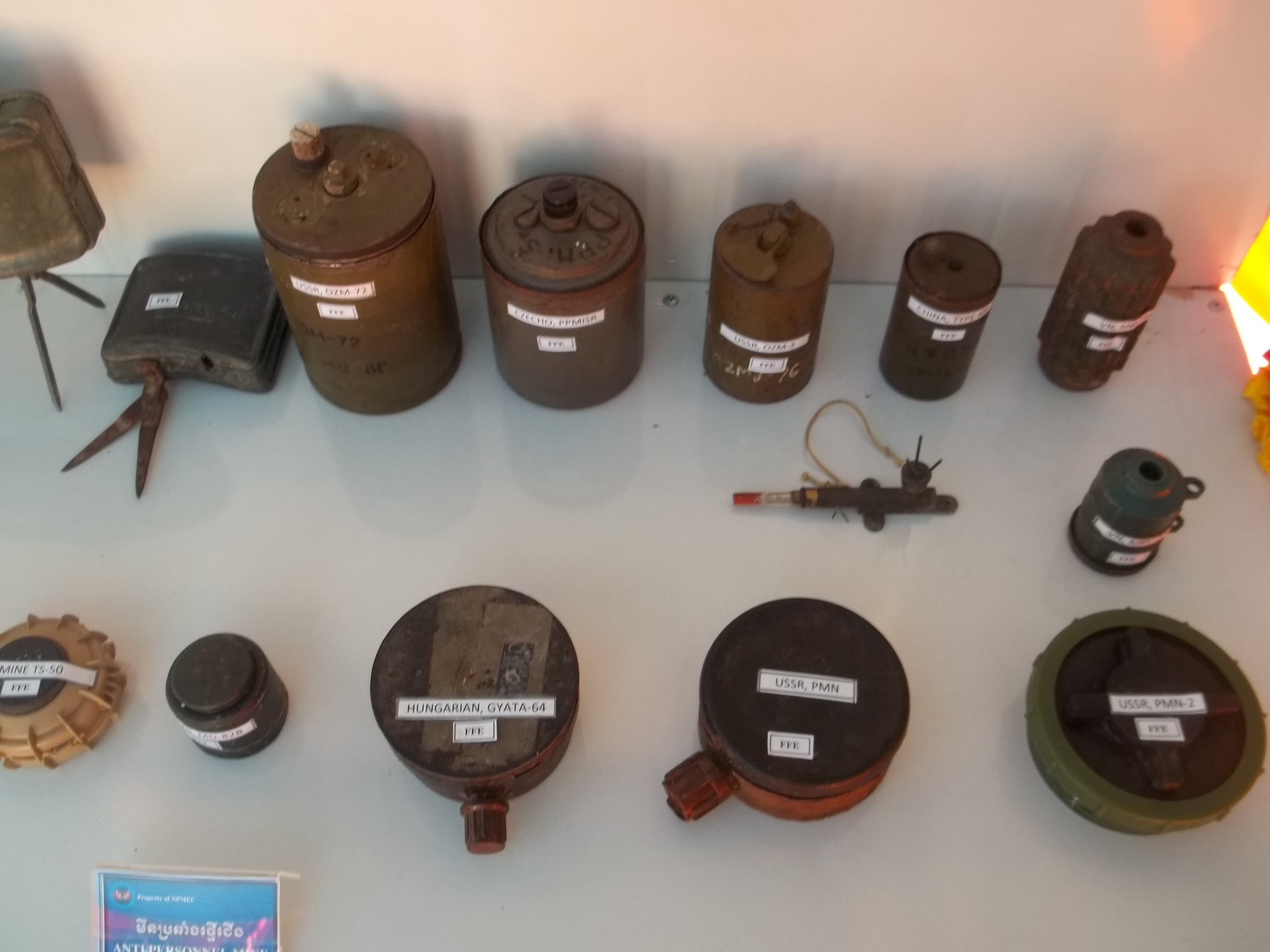
Made of plastic, metal or other materials, they contain explosives and some contain pieces of shrapnel. They can be activated by direct pressure from above, by pressure put on a wire or filament attached to a pull switch, by a radio signal or other remote firing method, or even simply by the proximity of a person within a predetermined distance.
When triggered, a landmine unleashes unspeakable destruction. The blast causes injuries like blindness, burns, destroyed limbs and shrapnel wounds. Sometimes the victim dies from the blast, due to loss of blood or because they don’t get to medical care in time. Those who survive and receive medical treatment often require amputations, long hospital stays and extensive rehabilitation.
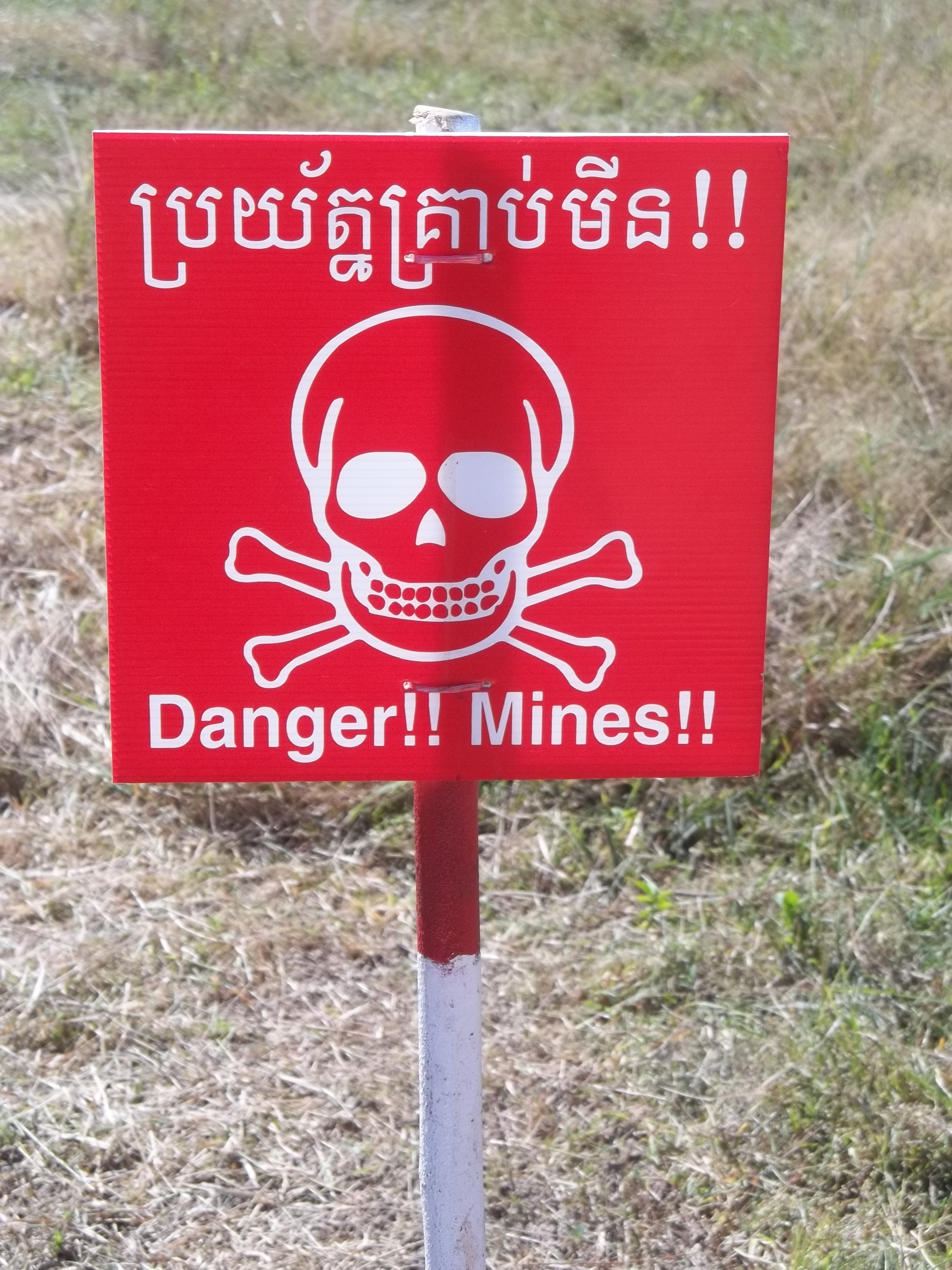
Stepping on a blast antipersonnel mine will invariably cause foot and leg injuries, and secondary infections usually resulting in amputation. Fragmentation mines project hundreds of metal fragments, showering the victim with deep wounds. Bounding fragmentation mines are more powerful versions: they spring up about 1 meter and then explode, firing metal fragments to a large radius. The Mine Ban Treaty defines an antipersonnel mine as: “a mine designed to be exploded by the presence, proximity or contact of a person and that will incapacitate, injure or kill one or more persons.” (Article 2.1)
Landmines are everywhere. According to Landmine Monitor, 66 states and seven areas not internationally recognized are confirmed or suspected to be mine-affected.
Nobody knows how many mines are in the ground. But the actual number is less important than their impact: it can take only two or three mines or the mere suspicion of their presence to render a patch of land unusable.
Arguments for a Ban
There are dozens of reasons to ban antipersonnel landmines and to campaign for this goal. Some of the moral, humanitarian, socio-economic and diplomatic arguments are given here.
The human costs
Antipersonnel landmines still maim and kill ordinary people every day. They blow off their victims’ legs, feet, toes and hands. They fire shrapnel into their faces and bodies. They kill.
Civilians bear the brunt
The vast majority of victims are civilians and not soldiers. Year after year, Landmine Monitor has reported that civilians account for 70 to 85 percent of casualties. This is not just during a conflict – most of the countries where casualties are reported are at peace.
Humanitarian law
Antipersonnel mines are indiscriminate and inhumane weapons and therefore go against international humanitarian law. The law of war imposes certain restrictions on how combatants operate. It says that they have to distinguish between civilian and military targets and that the injuries inflicted should be proportionate with military objectives. Antipersonnel landmines fail both the discrimination and the proportionality tests. Landmines are indiscriminate because a landmine is triggered by its victim, whether military or civilian. Landmines are inhumane because they inflict brutal injuries and have disastrous long-term consequences.
Long-term effects
Once planted, landmines don’t go away unless they are cleared away. Landmines sown during the First World War are still causing death and destruction in parts of Europe and North Africa. Landmines don’t obey peace agreements or ceasefires. The only way to prevent long-term damage is to stop any landmine use altogether and devote resources to clearing minefields and helping mine victims.
Lethal obstacles to economic growth
- Landmines slow repatriation of refugees and displaced people, or even prevent it altogether.
- They hamper the provision of aid and relief services and threaten, injure and kill aid workers.
- Medical treatment for landmine victims, where available, is costly, burdening an already overstretched health-care system.
- Communities are deprived of their productive land: farm land, orchards, irrigation canals and water points may be no longer accessible.
- Mines also cut off access to economically important areas, such as roads, electricity pylons and dams.
- A landmine incident may cost a family their breadwinner.
- Vocational training and support are often not available so many survivors struggle to make a living after their accident.
- On the flipside, a mine-affected country stands to gain international assistance for mine clearance and victim assistance once they ban landmines and join the Mine Ban Treaty. Donor governments are understandably reluctant to fund demining in countries until they have given up landmines altogether.
Children are victimized
A child who is injured by a landmine will face months of recovery… if they don’t die and if they get treated in time. Many are killed on the spot due to blood loss, shock or damage to vital organs. A growing child with a prosthetic limb will need it refitted and worn in each year. Some never return to school after their accident. Many face social exclusion. Like adult victims, they will face enormous practical, economic, social and psychological challenges in their rehabilitation and reintegration process.
Military arguments don’t hold up
The military arguments for using antipersonnel landmines are flawed. The International Committee of the Red Cross’ 1996 study Antipersonnel Landmines – Friend or Foe? concluded that antipersonnel mines are not indispensable weapons of high military value and they don’t necessarily offer any military advantage. In fact “their use in accordance with military doctrine is time-consuming, expensive and dangerous and has seldom occurred under combat conditions”, the group of military experts concluded. Landmines are not needed by a modern army. While in the past they may have protected borders and slowed advancing troops, now most armies are mobile and can get through a minefield in less than 30 minutes. Modern motion detection equipment, night detection technology and strategically placed guns can protect military installations, borders and other areas better than landmines. Also, landmines injure and kill soldiers – the very people they are meant to protect. For example, in the 1991 Gulf War, landmines caused 34% of USA casualties. In any case, the long-term humanitarian costs of mines far outweigh any limited military utility. This is why many former military personnel support a ban on antipersonnel mines and reject mine use, such as in this letter to the White House from U.S. military veterans and in this article by Lt. General Robert G. Gard Jr. (USA, Ret.), published in the Huffington Post in 2009. If a country’s military insists that antipersonnel landmines are still essential from a military point of view, suggest they look at the ICRC’s study mentioned above. Also, encourage them to do their own study to review their mine policy and its impact, including on their own soldiers.
The ban works!
Banning landmines makes a difference. We have made a great deal of headway since the Mine Ban Treaty came into force in March 1999. The global stigma attached to these weapons has led to a virtual halt in the global trade in antipersonnel mines, a sharp drop in the number of producers and a startling reduction in the number of governments laying mines, even among states that still refuse to officially join the treaty. Vast tracts of land have been cleared and put back into productive use; there has been widespread and extensive destruction of stockpiled mines; and most importantly, there are now fewer new mine victims each year.
Peace and security
Banning landmines increases peace and security and can be a valuable peace-building tool. For example, Greece and Turkey, both long-term rivals with border disputes used their shared commitment to joining the Mine Ban Treaty as a confidence building measure. Some states have joined the Mine Ban Treaty despite ongoing internal conflict e.g. Colombia and the Democratic Republic of Congo. In the case of Cyprus, the government joined the treaty although they are not in full control of the territory.
Border protection: there are alternatives
Mines are largely ineffective in protecting border regions, for example from smugglers, illegal immigrants or non-state armed groups. Ask your target government to provide information on whether and how landmines have been an effective deterrent for a specific stated purpose e.g. to stop smuggling. (Usually they cannot prove effectiveness.) Instead of offering protection, minefields terrorise and impoverish the communities living in the area. Alternatives exist and include: engaging in dialogue with a neighbour, mobile and fixed border patrol and motion detection equipments and barriers.
Every country has a duty
Everyone’s support is needed along the road to a mine-free world — no matter whether the country is mine-affected or not or whether they are large or small. Joining the Mine Ban Treaty is in the interests of mine-affected countries because it will spur international support for their landmine problem. For countries with no mines in stockpile or in the ground, joining the Mine Ban Treaty is also in their interests as they will gain a higher moral standing within the diplomatic world. As Kenya’s Ambassador Peter O. Ole Nkuraiyia, Secretary-General of the 2004 Nairobi Summit on a Mine-Free World observed: “We are hosting this landmark Summit as an act of solidarity with mine-affected countries in our sub-region, in Africa as a whole, and throughout the world, with a view to addressing the plight of mine victims.” All governments should listen to their citizens and the international community who demand that they take a stand, otherwise they risk becoming moral outcasts. Even interim steps that fall short of joining the Mine Ban Treaty are valuable e.g. the provision of information on landmine stockpiles, or voting in favor of the annual United Nations’ General Assembly resolution on the treaty.
History of Landmines
Until the Nineties, antipersonnel landmines had been used by almost all armed forces of the world, in one form or another. Thanks to the 1997 Mine Ban Treaty, landmine use has dramatically dropped. But the weapon still poses a significant and lasting threat.
How it started
Antipersonnel mines were first used on a wide scale in World War II. Since then they have been used in many conflicts, including in the Vietnam War, the Korean War, the first Gulf War. Precursors of the weapon are said to have first been used in the American Civil War in the 1800s.
Today, the weapon is still being used in a handful of conflicts.
Antipersonnel mines were initially developed to protect antitank mines and stop them being removed by enemy soldiers. They were used defensively, to protect strategic areas such as borders, camps or important bridges and to restrict the movement of another force.
A key characteristic of the weapon is that it’s designed to maim rather than kill an enemy soldier. The logic goes that more resources are taken up caring for an injured soldier on the battlefield than dealing with a dead soldier.
After a while, antipersonnel landmines began to be deployed on a wider scale, often in internal conflicts and started being aimed at civilians. They were used to terrorise communities, deny access to farming land and restrict population movement.
The practice of marking and mapping minefields was no longer followed strictly. As a result, civilians, peacekeepers, aid workers and soldiers alike had no way of knowing if they entered a minefield. Rain and other weather often shifted minefields. So without clear records, and with the impacts of weather and time, clearing up the mess after a conflict became even harder.
Military intelligence
Antipersonnel mines often harm the very people they were there to protect: the soldiers. In addition to mounting soldier casualties, there was growing opposition to mine use within military ranks. The soldiers argued that the limited and questionable military utility of the weapon is outweighed by its humanitarian costs.
Developments
Technological developments saw the production of systems for delivering mines from the air. These were then used in much larger numbers and mapping and marking became almost impossible.
Also, so-called “smart” mines were developed. These self-destructing and self-deactivating mines are meant to destroy or deactivate themselves after a designated period of time. However, like “dumb” or long-lived mines, this so-called “smart” variety are indiscriminate and inhumane weapons when armed. Also, some may fail to self-destruct or self-deactivate and so may remain live indefinitely. They tend to be dropped by air, often in larger numbers than ground delivered mines, and are not fenced, marked or monitored thus posing the same long-term risk to life and limbs as long-lived mines.
Production
In the past, more than 50 countries have produced antipersonnel mines, both for their own stocks and to supply others.
Thirty-nine nations have now stopped production, and global trade has almost halted completely. None of the 156 States Parties to the Mine Ban Treaty produces landmines anymore. Unfortunately, 12 states not party to the treaty continue to produce (or have not foresworn the production of) antipersonnel mines: China, Cuba, India, Iran, Myanmar, North Korea, South Korea, Pakistan, Russia, Singapore, the United States, and Vietnam. Of those, as few as three were actively manufacturing antipersonnel mines in 2009: India, Myanmar and Pakistan.
At the same time some non-state armed groups or rebel groups in various countries produce antipersonnel mines, mostly of the improvised variety.
For the latest updates see Landmine Monitor
What are the problems with this weapon?
The Landmine Crisis is a Global One. Landmines are indiscriminate weapons that maim or kill civilians every year. There are millions of landmines in the ground in one-third of the world’s nations. They cost as little as $3 to produce, but as much as $1000 to remove. The presence of landmines threatens people’s lives, and also prevents much-needed economic growth and development. Long after wars are over, landmines make land unusable for farming, schools or living, preventing people from rebuilding lives torn apart by conflict.
Why is a ban on landmines necessary?
Since 1945, landmines have been used throughout the world in wars of liberation, civil wars, and local conflicts, with a devastating impact on economic and political reconstruction. Landmines demoralize survivors as well as their families and communities, impeding the process of peace and reconciliation. Because they lurk undetectably in the ground, population movement is restricted, land cannot be cultivated, roads and bridges cannot be rebuilt and refugees cannot return to their homes. Survivors of landmine accidents often cannot work at their previous jobs and require retraining. Without a strong workforce, the pace of reconstruction slows.
For poor countries, clearing landmines places an additional burden on already meager resources. It costs from $300 to $1,000 to locate and destroy a single landmine. This is not the only expense. It costs $100 to $3,000 to provide an artificial limb to a landmine survivor. An adult must replace a prosthesis every two to three years and a child must have a new one every six months to a year.
Landmine Monitor
Landmine Monitor is a unique and unprecedented civil society based reporting network to systematically monitor and document nations’ compliance with the 1997 Mine Ban Treaty and the humanitarian response to the global landmine crisis. This initiative was established in June 1998 by the International Campaign to Ban Landmines and is coordinated by a core group of five non-governmental organizations. By collecting and analyzing data relating to antipersonnel mines, Landmine Monitor aims to evaluate the overall progress of the international community in eradicating this insidious weapon and by doing so improve the lives of those living at risk in mine affected communities.
Landmine Facts
- The International Campaign to Ban Landmines estimates that around 4,000-5,000 people were maimed or killed by landmines last year alone, and that millions more suffer from the agricultural, economic, and psychological impact of the weapon.
- The International Campaign to Ban Landmines estimates that there are tens of millions of landmines in the ground in 78 countries.
- UNICEF estimates that 30-40 percent of mine victims are children under 15 years old.
- The United States has 10.4 million APLs stockpiled, the third largest mine arsenal in the world.
- Landmines cost as little as $3 to produce and as much as $1,000 per mine to clear.
- Landmines have injured and killed thousands of U.S. and allied troops in every U.S.-fought conflict since World War II, including recently in Iraq and Afghanistan.
- The U.S. State Department estimates that fewer than one in four landmine amputees is fitted with a proper prosthesis.
- From 1969 to 1992, the United States exported 4.4 million antipersonnel mines, mostly to Afghanistan, Angola, Cambodia, Iraq, Laos, Lebanon, Mozambique, Nicaragua, Rwanda, Somalia, and Vietnam.
- U.S.-made or supplied APLs have been found in 32 countries, including Afghanistan.
- Landmines are indiscriminate killers that target civilians long after a conflict has ended. Most kinds of landmines last forever. Mines laid during WWII are still killing and maiming civilians.
- At the beginning of the 20th century, nearly 80 per cent of landmine victims were military personnel. Today, 90 per cent of landmine victims are civilians.
- Landmines set in motion a series of events that leads to environmental damage in the forms of soil degradation, deforestation, pollution of water resources with heavy metals and altering entire species’ populations through degrading habitats and altering food chains.
What is theOttawaProcess or the Mine Ban Treaty?
The political initiative launched in October 1996 and culminating in the opening for signature of the Mine Ban Treaty in Ottawa, Canada, in December 1997 is known as the Ottawa Process. The Ottawa Process was unorthodox, historic and unprecedented. The treaty, which prohibits the Use, Stockpiling, Production and Transfer of Anti-Personnel Mines and their Destruction, is the product of an unusually cohesive and strategic partnership between non-governmental organizations, international organizations, United Nations agencies and governments.
The treaty was drafted by Austria and developed outside of traditional diplomatic channels, in a series of meetings in Vienna, Bonn, Brussels and Oslo over the course of 1997. A group of likeminded governments formed a “Core Group” that, in close cooperation with the NGOs of the International Campaign to Ban Landmines and international organizations such as the International Committee of the Red Cross (ICRC), helped to steer the Ottawa Process. Significantly, the “friends of the Ottawa Treaty” spanned the regions of the world and included representatives in both mine-affected and mine-producing countries.
The Mine Ban Treaty was adopted in Oslo, Norway, in September 1997 and signed by 122 States in Ottawa, Canada, on December 3, 1997. It entered into force less than two years later, on March 1, 1999, quicker than any treaty of its kind in history. Now that the treaty has entered into force, states may no longer sign it, rather they may become bound without signature through a one step procedure known as accession. According to Article 16 (2), the treaty is open for accession by any state that has not signed.
For more information on the Mine Ban Treaty go to www.icbl.org.
States Parties
The 1997 Convention on the Prohibition of the Use, Stockpiling, Production and Transfer of Anti-Personnel Mines and on their Destruction (Mine Ban Treaty) was open for signature from 3 December 1997 until its entry into force on 1 March 1999. Now that the treaty has entered into force, states may no longer sign it, rather they may become bound without signature through a one step procedure known as accession. According to Article 16 (2), the treaty is open for accession by any state that has not signed.
Treaty Status
The Mine Ban Treaty is one of the world’s most widely accepted treaties: over 80% of the world’s countries are States Parties to the treaty.
GO TO TO SEE MAP OF COUNTRIES: http://icbl.org/en-gb/resources.aspx
|
|
“Antipersonnel mines cannot be aimed: they do not distinguish between the footfall of a soldier or a child. They lie dormant until a person or animal triggers their detonating mechanism. Landmines kill or injure civilians, soldiers, peacekeepers and aid workers alike. They are inhumane. When triggered, a landmine unleashes unspeakable destruction. A landmine blast causes injuries like blindness, burns, destroyed limbs and shrapnel wounds. Sometimes the victim dies from the blast, due to loss of blood or because they don’t get to medical care in time. Those who survive and receive medical treatment often require amputations, long hospital stays and extensive rehabilitation. The injuries are no accident, since landmines are designed to maim rather than kill their victims. Landmines steal lives, limbs and livelihoods. Mine deaths and injuries over the past decades now total in the hundreds of thousands. Most of the casualties are civilians and most live in countries that are now at peace. Landmines are a development disaster. Landmines deprive people in some of the poorest countries of land and infrastructure. Once there is peace most soldiers will be demobilized and give in their guns, mines however don’t recognize a cease-fire. They hold up the repatriation of refugees and displaced people. They also hamper reconstruction and the delivery of aid. Assistance to landmine survivors can be an enormous strain on resources. Landmine casualties deprive communities and families of breadwinners. Mines also kill livestock and wild animals and wreak environmental havoc. Landmines are everywhere…every region in the world is mine-affected. More than 75 countries are affected to some degree by landmines and/or unexploded ordnance. This is why we are involved…there is still work to be done! Sadly, antipersonnel landmines are still being planted today and minefields dating back decades continue to lie in wait of innocent victims. Vast stockpiles of landmines remain in warehouses around the world and a handful of countries still produce the weapon”. Antipersonnel landmines are still being laid today. These – and mines from previous conflicts – continue to claim victims in every corner of the globe each day. The situation has improved in recent years, but a global mine crisis remains and there is still a lot to be done before we live in a mine-free world. The ICBL: International Campaign to Ban Landmines is a network of more than 1,400 groups in over 90 countries, works locally, nationally and internationally to eradicate antipersonnel mines. Members include human rights, humanitarian, children, peace, disability, veterans, medical, humanitarian, mine action, development, arms control, religious, environmental and women’s groups. The ICBL works for a worldwide ban on antipersonnel landmines and universal membership of the 1997 Mine Ban Treaty, support of the needs and rights of landmine survivors and demining and risk education to safeguard lives and livelihoods. The campaign and its coordinator at the time, Jody Williams, were awarded the Nobel Peace Prize in 1997 in recognition of its achievements. (*ICBL: www.icbl.org)