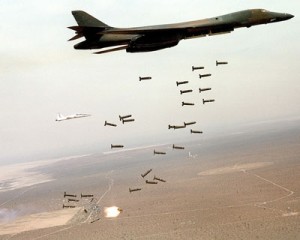
A cluster bomb, or cluster munition, is a weapon containing multiple explosive submunitions. These containers are dropped from aircraft or fired from the ground and designed to break open in mid-air, releasing the submunitions and saturating an area that can be the size of several football fields. Anybody within that area, be they military of civilian, is very likely to be killed or seriously injured. As so many of the submunitions fail to work properly, huge quantities are left on the ground and, like landmines, remain a fatal threat to anyone in the area long after a conflict ends. These weapons kill and injure people trying to rebuild their lives after conflict. They stop people from being able to use their land and access hospitals and schools. They can remain a threat for decades.WHY IS A BAN ON CLUSTER MUNITIONS NECESSARY? Simply put, cluster munitions kill and injure too many civilians. The weapon caused more civilian casualties in Iraq in 2003 and Kosovo in 1999 than any other weapon system. Cluster munitions stand out as the weapon that poses the gravest dangers to civilians since antipersonnel mines, which were banned in 1997. Israel’s massive use of the weapon in Lebanon in August 2006 resulted in more than 200 civilian casualties in the year following the ceasefire and served as the catalyst for governments to seek to create a legally binding international instrument tackling cluster munitions in 2008.The Problem: Cluster bombs have killed and injured thousands of civilians during their history of use and continue to do so today. They cause widespread harm on impact and yet remain dangerous, killing and injuring civilians long after a conflict has ended. One third of all recorded cluster munitions casualties are children. 60% of cluster bomb casualties are injured while undertaking their normal activities.
WHAT ARE CLUSTER BOMBS? Cluster bombs or cluster munitions are large weapons which are deployed from the air and from the ground and release dozens or hundreds of smaller submunitions. Submunitions released by air-dropped cluster bombs are most often called “bomblets,” while those delivered from the ground by artillery or rockets are usually referred to as “grenades.”
WHAT’S THE PROBLEM WITH THIS WEAPON? Air-dropped or ground-launched, they cause two major humanitarian problems and risks to civilians. First, their widespread dispersal means they cannot distinguish between military targets and civilians so the humanitarian impact can be extreme, especially when the weapon is used in or near populated areas. Many submunitions fail to detonate on impact and become de facto antipersonnel mines killing and maiming people long after the conflict has ended. These duds are more lethal than antipersonnel mines; incidents involving submunition duds are much more likely to cause death than injury.
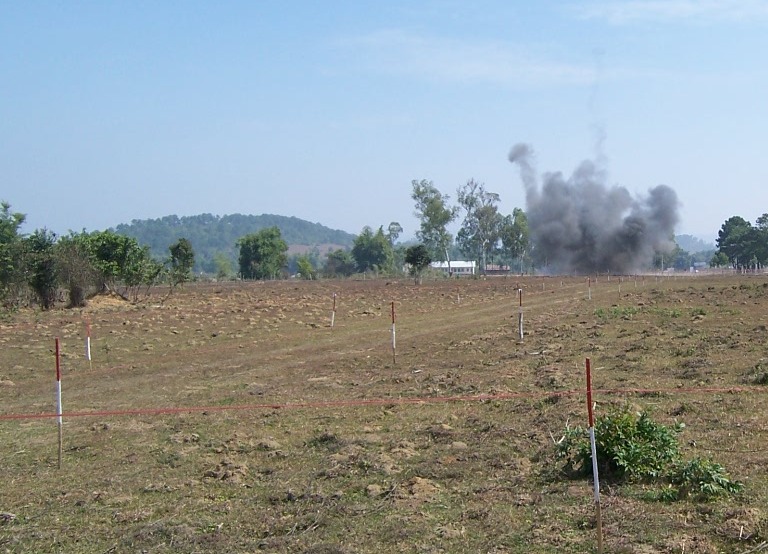
Affected countries and territories
The following countries and areas are believed to be contaminated by cluster munition remnants. Of this list, the most heavily affected states are Lao PDR and Vietnam, followed by Iraq and Cambodia.
- Afghanistan
- Azerbaijan
- Bosnia and Herzegovina
- Cambodia
- Chad
- Chile
- Croatia
- Democratic Republic of Congo
- Germany
- Iraq
- Lao PDR
- Lebanon
- Libya
- Montenegro
- Mozambique
- Serbia
- Somalia
- South Sudan
- Sudan
- Syria
- Ukraine
- Vietnam
- Yemen
as well as:
- Kosovo
- Nagorno-Karabakh
- Western Sahara
Others may have a small amount of contamination:
- Angola
- Argentina (Falkland Islands/Malvinas)
- Colombia
- Eritrea
- Ethiopia
- Georgia (South Ossetia)
- Iran
- Israel
- Jordan
- Kuwait
- Palau
- Russia (Chechnya)
- Saudi Arabia
- Tajikistan
- United Kingdom (Falkland Islands/Malvinas)
WHAT IS THE CLUSTER MUNITION COALITION? The Cluster Munition Coalition (CMC) is a global network of more than 350 civil society organizations working in some 90 countries to end the harm caused by cluster bombs. The CMC was launched in November 2003 and founding members include Human Rights Watch, Handicap International and other leaders from the Nobel Peace Prize-winning International Campaign to Ban Landmines, which secured the 1997 Mine Ban Treaty. Since the signing of the Convention on Cluster Munitions by 94 countries at the Oslo Signing Conference in December 2008, the CMC mobilized an intensive global ratification campaign to ensure that 30 countries ratified the Convention swiftly. This happened on 16 February 2010, less than two years after the treaty was formally adopted. The CMC now works for all states to come on board the Convention and to fully implement all its provisions.
WANT TO KNOW MORE? READ real life stories from people around the world who have had contact with cluster munitions.
Real-Life Stories and images can be found at the Image Gallery on Cluster Munitions.
To read more about the experiences of survivors of cluster munitions and their work to achieve a ban, visit the Ban Advocates web site.
To date 116 states have joined the convention, of which 91 are States Parties, and the remaining 25 are signatories that have yet to ratify the convention.
ORDER OF RATIFICATIONS/ACCESSIONS TO THE CONVENTION ON CLUSTER MUNITIONS
As of March 2015 The Convention on Cluster Munitions was signed by 94 states when it opened for signature in Oslo, Norway on 3 December 2008. On 16 February 2010, only 15 months later, the 30th state ratified the Convention, triggering its entry into force on 1 August 2010. Since the Convention entered into force, it is no longer open for signature. Instead, states that have not signed it must become bound through the process of “accession”.
Signatory states must still ratify the Convention now that it has entered into force: each country that has signed to Convention must ratify it in order to become a State Party. 116 countries have joined the Convention, 91 are States Parties (accessions in bold): 1. Norway (3 Dec 08) 2. Ireland (3 Dec 08) 3. Holy See (3 Dec 08) 4. Sierra Leone (3 Dec 08) 5. Lao PDR (18 Mar 09) 6. Austria (2 Apr 09) 7. Mexico (6 May 09) 8. Niger (2 Jun 09) 9. Albania (16 Jun 09) 10. Spain (17 Jun 09) 11. Germany (8 Jul 09) 12. Luxembourg (10 Jul 09) 13. San Marino (
Cluster Munition Monitor
The Cluster Munition Monitor was first released in 2010 and builds upon the 2009 report Banning Cluster Munitions: Government Policy and Practice, which was researched and written by Human Rights Watch and Landmine Action (now known as Action On Armed Violence), and published by the Monitor. Cluster Munition Monitor provides a global overview of developments in cluster munition ban policy, use, production, trade, and stockpiling for every country in the world, and also includes information on cluster munition contamination, casualties, clearance, and victim assistance.
CLUSTER BOMB FACTS
- Cluster munitions severely disrupt the lives and livelihoods of 400 million people worldwide
- 98 percent of cluster bomb casualties are civilians and 27 percent are children
- One cluster bomb contains hundreds of bomblets (or submunitions) and typically scatters them across an area the size of 2-4 football fields
- Bomblets are small, often the size of a ‘D’ battery or a tennis ball and have a failure rate of up to 30 percent; unexploded bomblets become de facto landmines
- At least 72 countries around the world stockpile cluster munitions and 34 are known to have produced more than 210 types of cluster munitions
- Cluster bombs impede economic development, restrict access to water and deprive children of safe access to education
- Cluster munitions have been used in at least 39 countries and territories
- The global stockpile of cluster bomb submunitions totals approximately 4 billion, with a quarter of these in U.S. hands
- Unexploded bomblets were responsible for the death of nearly 10% of the U.S. fatalities in the Gulf War
- The United States dropped 19 million in Cambodia, 70 million in Vietnam and 208 million in Laos
- The U.S. executed over 580,000 bombing missions over Laos, dropping, on average, an entire planeload of bombs every eight minutes, around the clock, for nine years.
- The most cluster contaminated areas are in Afghanistan, Cambodia, Iraq, Laos, Kosovo and Vietnam.
For more information on The Convention on Cluster Munitions go to www.stopclustermunitions.org.
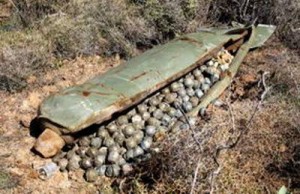
They cause widespread harm on impact and yet remain dangerous, killing and injuring civilians long after a conflict has ended. One third of all recorded cluster munitions casualties are children. 60% of cluster bomb casualties are injured while undertaking their normal activities. The Cluster Munition Coalition (CMC) is an international coalition working to protect civilians from the effects of cluster munitions by promoting universal adherence to and full implementation of the Convention on Cluster Munitions. The CMC has a membership of around 300 civil society organizations from more than 80 countries, and includes organizations working on disarmament, peace and security, human rights, victim/survivor assistance, clearance, women’s rights, faith issues and other areas of work. The CMC facilitates the efforts of NGOs worldwide to educate governments, the public and the media about the problems of cluster munitions and the solution through the global treaty banning the weapon”. (*CMC:www.stopclustermunitions.org)